Dr. Pradeep Kumar

Spine Tumor & infection management

Spine Tumor & infection management

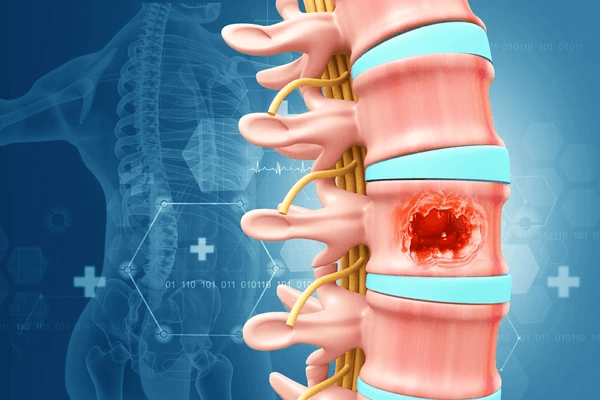
Spinal tumors and infections pose significant challenges due to the spine’s critical role in support, mobility, and neural protection. Tumors can be primary (benign like meningioma, hemangioma; malignant like chordoma, myeloma) or metastatic (commonly from breast, lung, prostate, kidney). Infections include pyogenic spondylodiscitis, tuberculosis (Pott’s disease), or postoperative.

Dr. Pradeep Kumar, with advanced musculoskeletal oncology training from Tata Memorial Centre, offers comprehensive management emphasizing neurological preservation and stability.

Diagnosis involves MRI (gold standard), CT for bone detail, PET-CT for staging, and biopsy (CT-guided or open) to confirm etiology.
Management of Spinal Tumors:

  • Medical: Pain control, steroids for cord compression, bisphosphonates/denosumab for lytic lesions, targeted therapy/hormonal for metastases.
  • Radiation: Stereotactic radiosurgery (SBRT) for precise tumor control with minimal neural damage.
  • Surgery: Indicated for instability, progressive neurology, or radio-resistant tumors.
    •  

Management of Spinal Tumors:

  • Medical: Pain control, steroids for cord compression, bisphosphonates/denosumab for lytic lesions, targeted therapy/hormonal for metastases.
  • Radiation: Stereotactic radiosurgery (SBRT) for precise tumor control with minimal neural damage.
  • Surgery: Indicated for instability, progressive neurology, or radio-resistant tumors.

Tumor Management Types

  • Conservative: Observation for asymptomatic benign tumors; medical therapy (bisphosphonates, denosumab) for metastases; chemotherapy/targeted agents.
  • Radiation: Conventional or stereotactic (SBRT) for sensitive tumors.
  • Surgical:
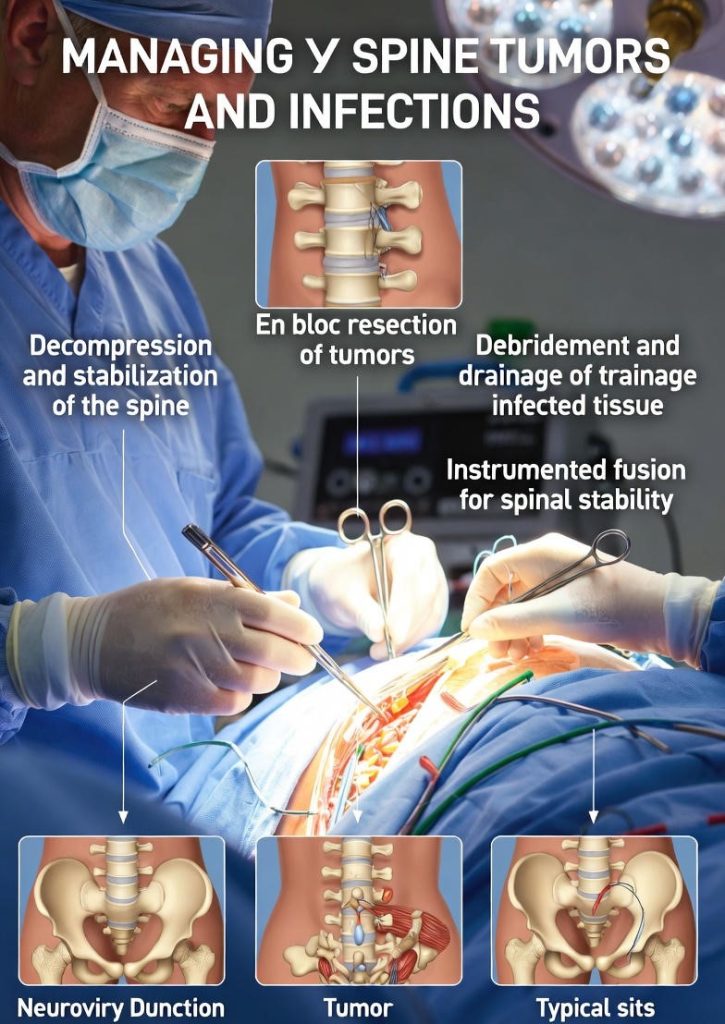
    • Palliative Decompression: Laminectomy for cord relief.
    • Stabilization: Pedicle screws/cages for instability.
    • Curative En Bloc Resection: For select primary malignancies.
    • Minimally Invasive: Vertebroplasty/kyphoplasty for painful collapse.

Infection Management Types

  1. Medical: Prolonged antibiotics (IV 6-8 weeks, then oral) based on culture; anti-TB drugs for tuberculosis.
  2. Surgical:
    • Debridement & Drainage: Remove pus/necrotic tissue.
    • Instrumented Fusion: Anterior/posterior fixation for stability.
    • Minimally Invasive: Percutaneous/endoscopic abscess drainage.

Multidisciplinary approaches with oncology, neurology, and ID specialists optimize outcomes. Early MRI/biopsy guides therapy—seek prompt care for back pain, fever, or weakness.